
JOHN GAGLIARDI WAS FEEDING THE CATS BEFORE FEED THE CATS EXISTED
Football has always had a strange relationship with suffering. If a little practice is good, more must be better. If running makes players tired, then more running must make them tougher. If tackling is important on Saturday, then tackling every day must make players better at it. And if athletes aren’t exhausted when practice ends, apparently the coach didn’t work them hard enough.
Football is the most traditional sport, the most patriotic sport, the most religious sport, and the most militaristic sport. Football coaches are typically zealots who are stubborn, confident, and masculine. Many believe that football is the only sport that turns boys into men.
John Gagliardi never bought into that logic.
Gagliardi coached football for 70 years and retired as the winningest coach in college football history with 489 victories. At Saint John’s University, he won four national championships and built one of the most successful programs in college football. Yet what fascinates me most about Gagliardi isn’t how much he won. It’s how completely he rejected many of the traditions that coaches believed were necessary to win.
He didn’t tackle in practice. He didn’t believe in meaningless conditioning. He disliked excessive rules. He avoided activities that had little connection to the game. He wanted practices efficient, players healthy, and the atmosphere enjoyable. Given a choice between strong players and quick players, he wanted the quick ones.
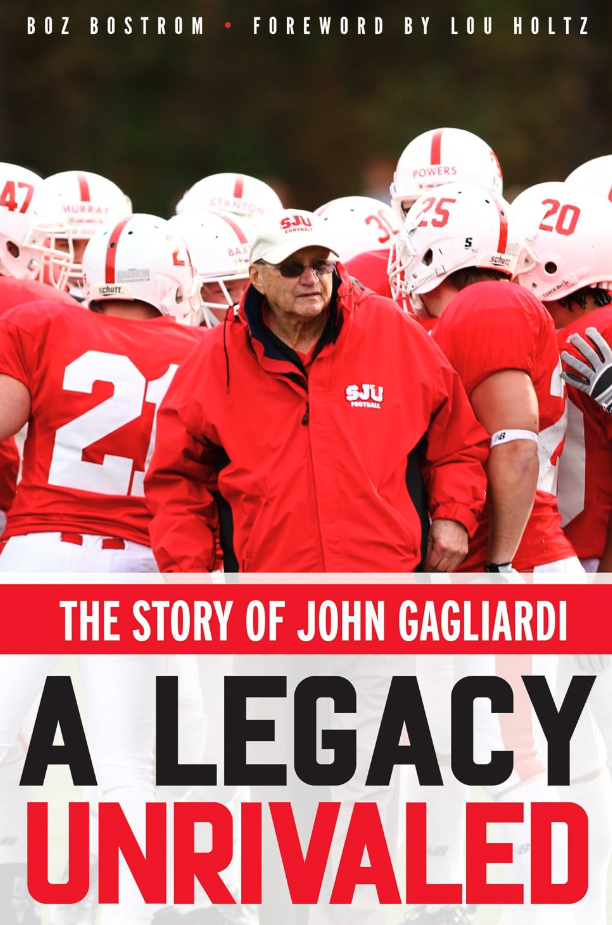
Reading Boz Bostrom’s A Legacy Unrivaled: The Story of John Gagliardi, I kept having the same thought: John Gagliardi was feeding the cats decades before Feed the Cats existed. Gagliardi, who would have turned 100 this year, was 73 when I started FTC in 1999.
Obviously, Gagliardi never used that terminology. Feed the Cats came from a different sport (track) and a different generation. But the underlying principles are remarkably similar: protect athletes, prioritize speed, eliminate unnecessary work, keep people fresh, practice what matters, build confidence, and create an environment kids actually want to be part of.
Gagliardi once summarized his philosophy better than almost anyone could. When asked whether he had worked harder than other coaches, he said, “I don’t know about that, but I think I worked on the right things. I worked on things that made a difference.”
That sentence could serve as the mission statement for essentialist coaching.
Most coaches build programs by addition. Another drill, another meeting, another lift, another conditioning period, another practice segment, and another rule. Gagliardi built much of his philosophy through subtraction. He looked at traditional football practices and asked whether they actually helped players play football. His conclusion was wonderfully simple: “I think there’s a lot of rituals out there that have no correlation whatsoever to football. So we just don’t do ’em.”
That isn’t laziness. It’s essentialism.
Gagliardi started questioning football tradition while he was still a high-school player. He remembered practices filled with laps and calisthenics while linemen remained confused about whom they were supposed to block. As a tailback, he was the guy getting hit when assignments were missed. When he eventually found himself in charge, he listened to the players who said they didn’t want to spend time on things such as laps and calisthenics. Instead, they devoted more time to running plays, discussing assignments, and understanding what would actually happen in games.
“We focused our time on what guys actually needed to know for the game,” Gagliardi recalled. Then, with typical understatement, he added, “I guess I stumbled on something that worked.”
He had stumbled onto something that coaching often forgets: practice should improve performance, not merely create fatigue. #PerformInPractice
One of the central pillars of Feed the Cats is Tired is the Enemy, Not the Goal. That statement is sometimes interpreted as being anti-work. It isn’t. Fatigue is simply viewed as a cost rather than an objective. Athletes don’t train in order to become tired; they train in order to become better. Gagliardi seemed to understand that instinctively. He wasn’t interested in winning the Tuesday afternoon suffering contest. He wanted to win on Saturday.
That mindset eventually led him to one of the most radical decisions in football: eliminating tackling in practice.
Gagliardi traced the decision to watching star running back Jim Lehman get injured. His reasoning was devastatingly logical: “No matter how much practice we had, we couldn’t make up for Jim’s talent—you can’t lose those key players.” Eventually, he moved away from tackling altogether. And while many teams protected quarterbacks in practice, Gagliardi extended the same logic to everyone else: “Those other guys have mothers, too.”
That line is funny, but the idea behind it is serious. Every collision has a cost. Every practice has a cost. The question isn’t simply whether an athlete can survive another rep. The question is whether that rep makes the team better or merely creates additional risk.
Feed the Cats expresses the idea another way: 100% healthy and 80% in shape beats 80% healthy and 100% in shape. Gagliardi understood that no conditioning program could replace a talented player standing on the sideline. You don’t get bonus points on game day because Tuesday was brutally hard. The goal of practice is to prepare players for competition, not to see how much practice they can survive.
That philosophy connects directly to another Feed the Cats principle: Let the Game Be the Hardest Thing You Do. Traditional football has often preached the opposite. Coaches proudly make practice harder than games under the assumption that Saturday will then feel easy. Gagliardi saw another possibility: perhaps excessively hard practices simply leave players less capable of performing when the game finally arrives.
Freshness isn’t weakness. Freshness is a performance advantage. Freshness also prevents injuries.
The Gagliardi quote that may have surprised me most, however, had nothing to do with practice duration or tackling. It was about athleticism. Asked about what his team needed, Gagliardi said, “I think we need to get quicker.” Then he made his priority even clearer: “Given a choice of strong guys or quick guys, I’ll take the quick guys.”
He pointed to Saint John’s 2003 national championship victory over Mount Union. Mount Union outweighed his team by an average of about 40 pounds, but Gagliardi explained, “We were quicker than them, and we executed our game plan.”
I could hardly invent a better endorsement of the first pillar of Feed the Cats: Speed is the Tide that Lifts All Boats.
Football has traditionally worshiped size, strength, toughness, and conditioning. All of those things can matter, but speed changes everything. Speed creates separation, closes space, covers mistakes, and expands possibilities. Gagliardi wasn’t a sprint coach or a modern performance specialist. He was a football coach born in 1926 who understood that quick athletes who know what they’re doing are awfully difficult to beat. I am 100% sure that John Gagliardi, if coaching today, would be timing sprints twice a week and proudly proclaiming his team was “Sprint-Based.”
And knowing what they were doing mattered enormously to him. Gagliardi’s famous goal was to have “ordinary guys do ordinary things extraordinarily well.” He wasn’t trying to replace traditional football with gimmicks. Quite the opposite. He wanted to strip away the clutter and spend more time getting very good at things that actually decided games.
Simple doesn’t mean easy. Simple means focused.
“Simple ain’t easy.” ~Thelonious Monk
Another remarkable part of Gagliardi’s philosophy was his attitude toward players themselves. Coaches have been complaining about “kids today” for generations. Gagliardi coached young men across seven decades, yet when asked how players had changed, he answered, “I don’t think they have changed a lot. They still are good kids.”
Those five words—they still are good kids—say a lot about the environment he created.
If coaches assume kids are lazy, they coach them as if they are lazy. If they assume players can’t be trusted, they build programs around control. If they assume athletes need constant discipline and criticism, practices become exercises in obedience. Gagliardi began from a different place. He liked his players, listened to them, and treated them like people.
Bostrom writes that “John understood that people learn better and perform better when they are happy and relaxed.” He deliberately created an atmosphere of fun and laughter. That doesn’t mean standards were low. Gagliardi won 489 games. It means he never accepted the false choice between enjoyment and excellence. #HappyAndHealthy
One of my favorite Feed the Cats principles is Make Practice the Best Part of a Kid’s Day. Gagliardi seemed to understand exactly why that matters. Discussing why so many players continued showing up, he observed that they wouldn’t keep coming if they were getting “beat up” every day. He also pointed out, “We don’t chew them out every day. Who wants that?”
“Who wants that?” might be one of the best questions a coach can ask.
Would I want to play for me? Would I look forward to my practices? Would I want someone screaming at me every afternoon? Would I voluntarily return tomorrow?
Gagliardi also understood that confidence could be coached just as surely as it could be destroyed. He preached confidence relentlessly and continually focused his players on the positive. After particularly painful losses, he didn’t always believe in endlessly dissecting mistakes. Sometimes his teams didn’t watch the film at all. His memorable advice was to treat a terrible game like something in the toilet: “You just flush it down. You don’t pick it up and examine it.”
Gagliardi explained that he saw little value in knocking players down when they already felt terrible. “That doesn’t make it better; it makes it worse,” he said, adding that criticism was often more effective when things were going well.
Perhaps his greatest act of subtraction involved control itself. Gagliardi said he wasn’t a fan of rules. “We only have one rule,” he said, “and that is the golden rule.” Instead of trying to control every moment, he empowered people, listened to players, and treated them with respect.
He also kept football in perspective. During training camp, he would hold a dime in the air and explain that something so small could block the sun if held close enough to your eye. “This small dime can block your view of the sun and is kind of like football,” he told his players. “Don’t let football block your view of your life.”
Maybe that perspective helped him avoid turning football into something it wasn’t. The game mattered enormously to Gagliardi, but the people playing it mattered more.
And then there are the results. In his first 30 years at Saint John’s, Gagliardi won 74 percent of his games and 11 conference championships. In his final 30 years, he won 80 percent and 16 conference championships. Between 1991 and 2009, his teams won 85 percent of their games and 14 conference titles. His philosophy didn’t become obsolete as football evolved. If anything, Gagliardi became more successful.
That’s why his story resonates so strongly with me.
Feed the Cats didn’t come from John Gagliardi, and I don’t want to rewrite history by pretending that it did. But when I read about a coach who eliminated unnecessary work, protected athletes, valued quickness, prioritized health, rejected fatigue for fatigue’s sake, created enjoyable practices, trusted kids, built confidence, and focused relentlessly on the things that actually mattered, I recognize the philosophy.
Coaches are naturally attracted to addition. We are constantly searching for the next drill, the next exercise, the next piece of technology, the next way to do more.
Gagliardi offers the more difficult question:
What can we eliminate?
What doesn’t transfer? What costs more than it produces? What are we doing only because coaches before us did it? What would happen if we stopped?
John Gagliardi answered those questions for 70 years. His conclusion was remarkably simple: work on the right things. Work on things that make a difference. Practice the DISCIPLINED pursuit of LESS, not the UNDISCIPLINED pursuit of MORE.
That is essentialism.
That is high performance.
And decades before I ever called it Feed the Cats, John Gagliardi was already feeding them.
He just called it common sense.

A wonderful article. Grateful for being introduced to a coach who deserves a place in sports history shoulder to shoulder with the legends.