
THE CARROT AND THE STICK
Most of us have been raised with rewards and punishments, the carrot and the stick.
B.F. Skinner (1904-1990) had a huge impact on American education. Skinner’s work on operant conditioning (aka “Behaviorism”), which holds that rewards and punishments shape and maintain behavior, made him famous. His work was done on rats and then applied to children.
As you can probably guess, I don’t think we should treat kids like rats.
There’s no question I grew up in Skinner’s educational model. Classroom rules and consequences were common throughout my childhood. Grades could be either a reward or a consequence. The reward of good grades was parlayed into the promise of attending a good college, getting a terrific job, and making tons of money. Bad grades resulted in failure, not graduating, not going to college, and living in a van down by the river. Bad grades would also keep you from playing sports.
In contrast, I was raised in a home where behavior was taught without rewards and punishments. I was never threatened, grounded, or physically punished. Nothing I loved was ever taken from me to teach me a lesson. Instead, my parents modeled good behavior. I was taught how to act. I simply respected my parents and sought their approval.
By the way, B.F. Skinner’s ideas were not universally accepted. Many educators believed his ideas to be dehumanizing and authoritarian.
As coach, I see rewards and consequences as extrinsic motivation. I believe the best athletes have INTRINSIC MOTIVATION. I believe kids are good at what they like and obsessed with what they love. I believe that when you love your work, you don’t have to be pushed; you feel pulled. I believe the job of a coach is to help kids to “build their own house.”
COACH ASKS FOR ADVICE
The following is a question from a head football coach who is transitioning from “old school” to a “feed the cats” approach.
This coach who contacted me described his old-school roots… “I am the epitome of the old school football coach you describe in your initial articles and all your podcasts – bad genetics, no fast twitch, son of a football coach, always loved the weight room, believe in toughness, great effort, and extreme amounts of hard work.”
His question inspired me to write my first article in over a year. This question stirred my blood.
“How does a ‘feed the cats’ program discipline?”
“Case in point, I have several young men who have chosen not to participate in our summer program. If they attempt to show up in August and play, my initial thought was, ‘Do not allow them to play this fall.’ My thinking is, ‘If I allow them to play, we will never get to the point where we can have a quality developmental off-season/summer program, which is one of the reasons they have never won here!’”
“My top assistant insists we need those kids for depth (and one of them is really talented!). We are a small school. He thinks we need to allow them to earn their way back but make it so public and so hard and so much running that no one will ever want to go through that again. What guidance would you give?”
FEED THE CATS APPROACH
In my first year at Plainfield North (2006-07), we lost our head football coach, Dan Darlington, and our defensive coordinator after game #2. Our record was 1-8 playing a varsity schedule without seniors. Plainfield North’s first graduates were the Class of 2008.
The interim head coach was Tim Kane. I know Tim pretty well because his dad and my mom are brother and sister (Larry Kane and Paula Kane Holler). Larry Kane was a terrific high school football coach and was a teammate of my dad (Don Holler) at Millikin University.
I sat in Tim’s basement one evening after the 2006 season ended and showed him a video of my speed training from Harrisburg (IL) and Franklin (TN).
We developed a plan for the winter. We would train strength and speed five days a week from November through February. We would sprint Monday, Wednesday, and Friday. We would do X-Factor (exercises that enhance speed) on Tuesday and Thursday. While our best athletes were on the track, our lesser athletes would lift. After 60 minutes, we would flip groups, sending our best athletes to the weight room with no need to warm up.
Tim Kane had not yet been named the head coach for 2007-08, and I was yet to be named the offensive coordinator, but those two things eventually happened.
I will never forget how excited Tim was by the time we had finalized our winter plan.
Tim said, “We will make attendance mandatory!”
I responded, “No, we will make it so good that kids will want to attend.”
I will never forget Tim’s response: “Well, if we don’t have good attendance, we will make it mandatory!”
I laughed.
Bear Bryant and “Feed the Cats” were attempting to find common ground.
By the way, the “make it so good they will want to attend” must have worked fairly well. Plainfield North played for the state championship just nine years later, losing to East St. Louis 26-13. Not bad for a new school.
In the winter of 2006-07, we had over 140 boys on our roster, and daily attendance was always over 100. Remember, half of those athletes were lifting while the other half were speed training. Tim Kane ran the weight room. I ran the speed training. We did record, rank, and publish. We celebrated improvement with enthusiasm. There has never been a better off-season program at a school with an all-time winning percentage of 11%.
In that first year (2007), we had only three guys sub 4.60 in the 40-yard dash. The year before playing for the IHSA State Championship, we had 31 sub-4.60 in the 40. The winter following our breakout football season, we had 32 sub-4.60. We may have lost to East St. Louis 26-13, but we were the faster team.
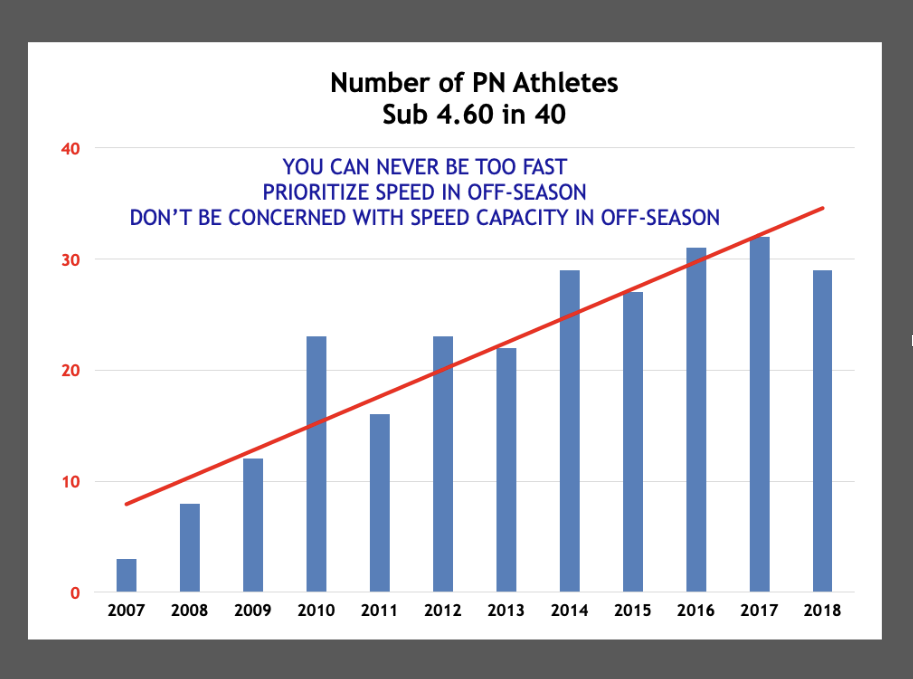
The program was non-mandatory and was open to every boy at Plainfield North. Several single-sport track athletes decided to play football because they loved winter workouts. New kids showed up every week. Once a basketball player got into trouble for getting timed in the 40.
I wrote an article for SimpliFaster in 2016 about our winter program, RECORD RANK AND PUBLISH: 8 WEEKS OF ALACTIC TRAINING.
SUMMER ATTENDANCE
Make summer workouts attractive to athletes. Ditch the Junction Boys (Bear Bryant) approach of weeding out the weak players and building mental and physical toughness in 100+ degree heat. Stop focusing on conditioning. Stop breaking kids.
Summer football is not Special Ops training. You are preparing teenagers for a game. You are developing athletes who want to play football for you.
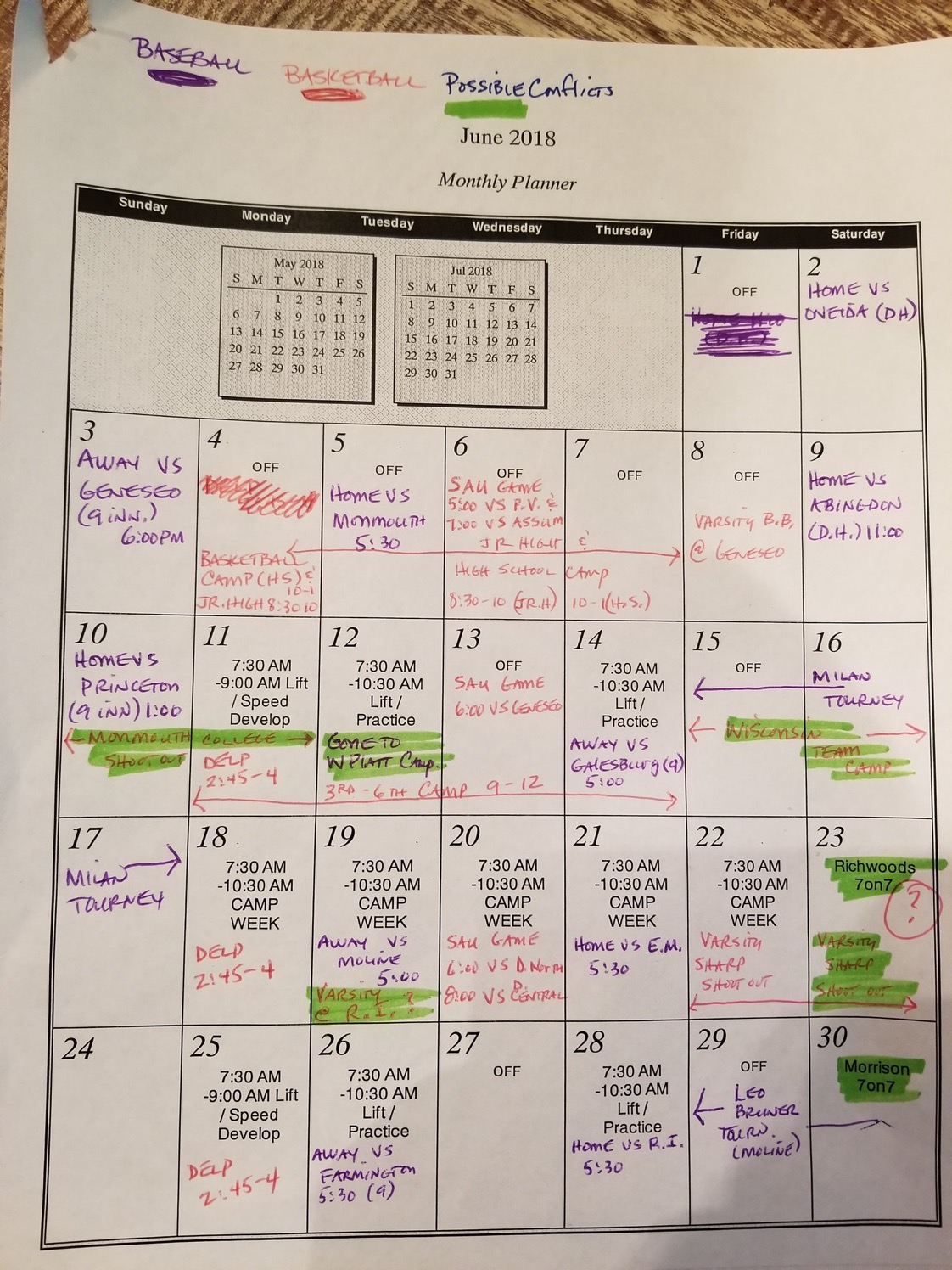
The best athletes have busy summers. Summer is a shitshow of conflicts between football, basketball, and baseball. Some athletes have no transportation. Kids from solid families are often encouraged to work. Good families often prioritize vacations and family reunions. You may wish football would be the one and only priority of every athlete, but that’s not realistic. Just because you are single-minded as a coach doesn’t mean you should reward and consequence kids into adopting the same mission.
The calendar below was posted by a parent on May 31, 2018. Maybe coaches should take a deep breath and understand the effects of mandated summer programs. It’s no wonder athletes feel pushed into choosing just one sport.
I would suggest the purpose of summer workouts should be BUILDING ATHLETES. Sprint fast, lift heavy, jump high/far, and bounce. Secondly, football skills need to be improved. As icing on the cake, it would be nice to install basic schemes and develop a depth chart so you can hit the ground running on the first day of practice.
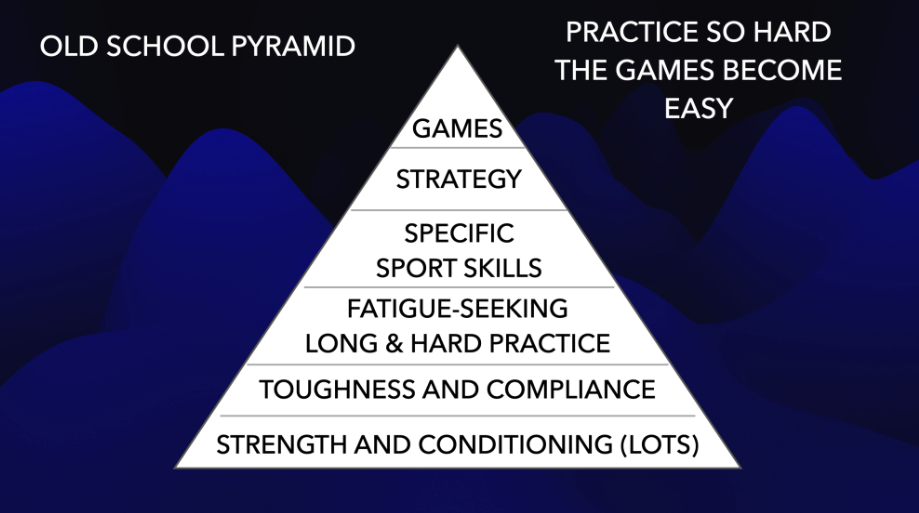
The better pyramid ⤵️
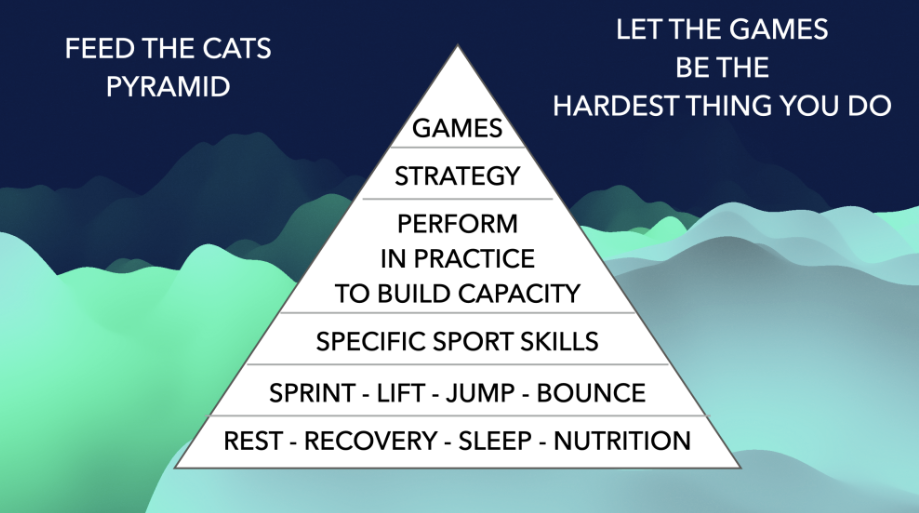
But how do you make kids to WANT to attend summer football workouts?
- Practice “The Disciplined Pursuit of Less.” Keep practices short and crisp. No conditioning. Tired is the enemy, not the goal. Don’t burn the steak. Never let today ruin tomorrow.
- Gamify practice. Compete. Time. Measure. Record, Rank, and Publish. Celebrate improvement with enthusiasm.
- Accept a new way to “get in shape.” Instead of MINDLESS CONDITIONING, get in shape by increasing speed (speed reserve) and patiently stacking anaerobic work to build capacity.
- Find times to work out that do not conflict with baseball, basketball, etc. Less is more. Doing less always creates quality.
DO YOU ALLOW KIDS TO PLAY FOOTBALL WITHOUT PARTICIPATING IN THE SUMMER PROGRAM?
Yes, without hesitation. Everyone who shows up for football in August should be welcomed. No conditioning test. No penalties for missing summer work. No extra running. (AND, NEVER USE RUNNING AS A PUNISHMENT.)
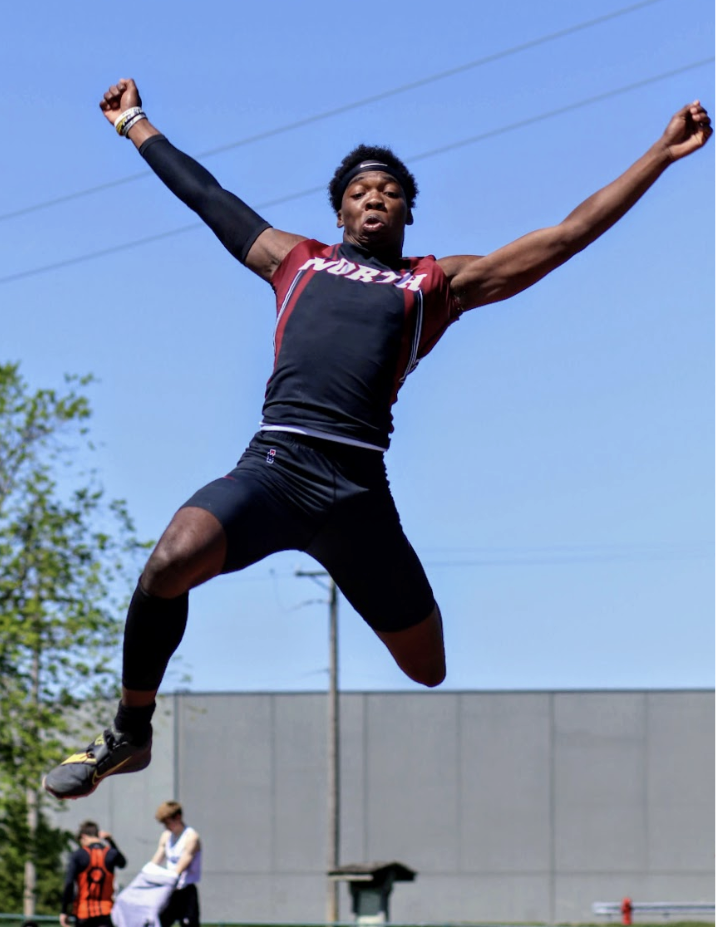
Last summer, Plainfield North’s Keith Cyracus was leaning towards not playing football his senior year after starting as a junior (cornerback). Keith had long jumped 23’0” and set our school record in the spring of 2024. Keith served as captain of the track team and was a spectacular student (plans to be an orthopedic surgeon). Keith did summer track in 2024 and did not attend football workouts. Instead of giving Keith an ultimatum, Coach Anthony Imberdino left the door open for Keith to join the football team in August. Keith played and was voted first-team All-Conference.
INCENTIVES
If you want to reward kids who attended summer workouts, there are many options. You could give helmet stickers for attendance. You could have a cookout for everyone meeting a certain attendance threshold. T-shirts could be the attendance prize.
I still believe the best reward would be the combination of a GREAT EXPERIENCE and tangible ATHLETIC IMPROVEMENT, that directly leads to WINNING GAMES.
There should be no punishment for non-attendance. Period. Unlike in-season practices, summer practices should be encouraged but never mandatory.
Something else to consider… if kids can skip your summer football and still favorably compete with those who did all you asked, does your summer football have any value? Call me crazy, but I’ve seen teams who would have been better off not practicing in the summer.
GARRETT MUELLER
Stewartville has won 28 in a row and have won back-to-back Minnesota State Championships.
“90% of our guys are multisport athletes. Nothing is required in terms of being able to play football in the fall, and there are a few who don’t join us. There are no punishments or consequences when the season starts. We often talk about being prepared and building your house. I’d say we have 95% of our football guys training with us. We call the program “Iron Tiger,” and it’s really become a well-known brand name in our community. Kids who attend 90% of the summer sessions get a Nike T-shirt or hoodie that has “Stewartville Iron Tiger” on it. They wear them like a badge of honor.” ~Garrett Mueller
BRAD DIXON
Since 2011, Camp Point Central H.S. is 136-27 under Brad Dixon. They are 72-11 (.863) since they started to Feed the Cats, aka “Sprint-Based Football”, including a state championship in 2023.
The summer of 2025 at Camp Point includes 4 days of “Mini-Camp”, 2 days of “11 on 11 Joint Practices” (travel to other schools), and 4 days of “Team Camp”. The entirity of the football summer is just TEN DAYS of showing up. Good for kids. Good for coaches. Good for families.
If you attend 80% of summer workouts at Camp Point Central, you get a T-shirt.
Brad Dixon encourages multisport athletes. He meets kids where they are at. Workouts are only scheduled on Tuesdays, Wednesdays, and Thursdays. This allows kids to play in weekend tournaments or travel with their family.
Less than a handful of football players don’t attend summer workouts but they are seldom kids who will play meaningful minutes. There’s no official consequence for not attending. However, kids not attending will not become stronger, faster, better football players. If you want to be a great football player, you show up for Camp Point Central’s ten contact days. That’s the way it should be!
+++
FOR THOSE OF YOU LOOKING FOR MORE CONTENT
SPRINT-BASED FOOTBALL PODCAST: (found on Spotify and Apple Podcasts)
- Kick-Off Episode with Tony Holler, Plainfield, IL
- Brad Dixon, Camp Point Central HS, IL
- Garrett Mueller, Stewartville HS, MN
- Jon Hersel, Saraland HS, AL
- Dan Quesenberry, Ravenwood HS, TN
- Erik Becker, Hand HS, Madison, CT
- Pedro Arruza, Randolph-Macon College, VA
- Chris Korfist, Sprint Guru, IL
- Ric Arand, Lena-Winslow HS, IL
- John Shaw, Tennessee Titans, TN
- Kurt Hester, University of Houston, TX
- Steve Bell, Augustana College, IL
- Nick Micetich, Minooka HS, IL
- CiCi Murrya, Speed Lab, CA
- Hal Mumme, Air Raid Offense, Scheduled to record on July 27th!
+++
FEED THE CATS PODCAST: Spotify, Apple Podcasts, YouTube
- Adam Archuleta, “Freak of Training”
- Brent Strickland, Cognitive Scientist, Paris, France
- Adam Archuleta with Dan Fichter, CNS Training
- Rus Bradburd, author of “Big Time”
- Douglas Heel, “Be Activated”
+++