
 FEED THE LIONS: AUGUSTA CHRISTIAN SCHOOLS
On April 17th, 2026, Augusta Christian (Georgia) initiated one of the most ambitious educational projects I’ve seen in my 67 years tied to schools.
Athletic Director Bill Brindley had learned to feed the cats as a college soccer coach from Brent Strickland. Brent was the guy who brought me to Nantes, France, back in December of 2023 to spread the ideas of Feed the Cats to French soccer coaches.
Dr. Brent Strickland was born and raised in Columbia, South Carolina, and grew up in a coaching family. He did his doctorate in cognitive and developmental psychology at Yale University. He is now a tenured researcher at the National Center for Scientific Research in Nantes and Paris, France. His work focuses on understanding universals of human cognition. Recently, he’s been working on athletic and cognitive development in youth soccer in France.
Tyler Thielges is AC’s “Director of Sports Performance.” His introduction to Feed the Cats came as the track coach at LaMoure H.S. in North Dakota. Tyler saw the benefits of a FTC approach first-hand.
When Bill Brindley met Tyler Thielges, Feed the Cats became their common ground. Both Bill and Tyler are new to Augusta Christian.
Fast forward to April 17th, 2026.
 I had the opportunity to do two one-hour presentations to Augusta Christian coaches. Both were well received.
In the evening, over 600 people from the Augusta Christian community and the community at large attended an event called “Feed the Lions.” (It’s estimated that half of the crowd were not associated with Augusta Christian.)
There was a carnival atmosphere featuring balloons, music, and food.
From 6:30 to 7:15 kids sprinted on a SHREDmill (shout-out to Tony Villani for getting it delivered on the day of the event). On the SHREDmill, kids got rated in mph. The other stations included a measured vertical jump, a measured horizontal jump, a timed 5-into-10 fly, and “Multiple Object Tracking” on a computer to test perceptual speed. 5 tests, 5 quantified results.
At 7:30, athletic director Bill Brindley introduced the idea of K-12 and all-sport “Feed the Cats” alignment that will be branded as “Feed the Lions.”
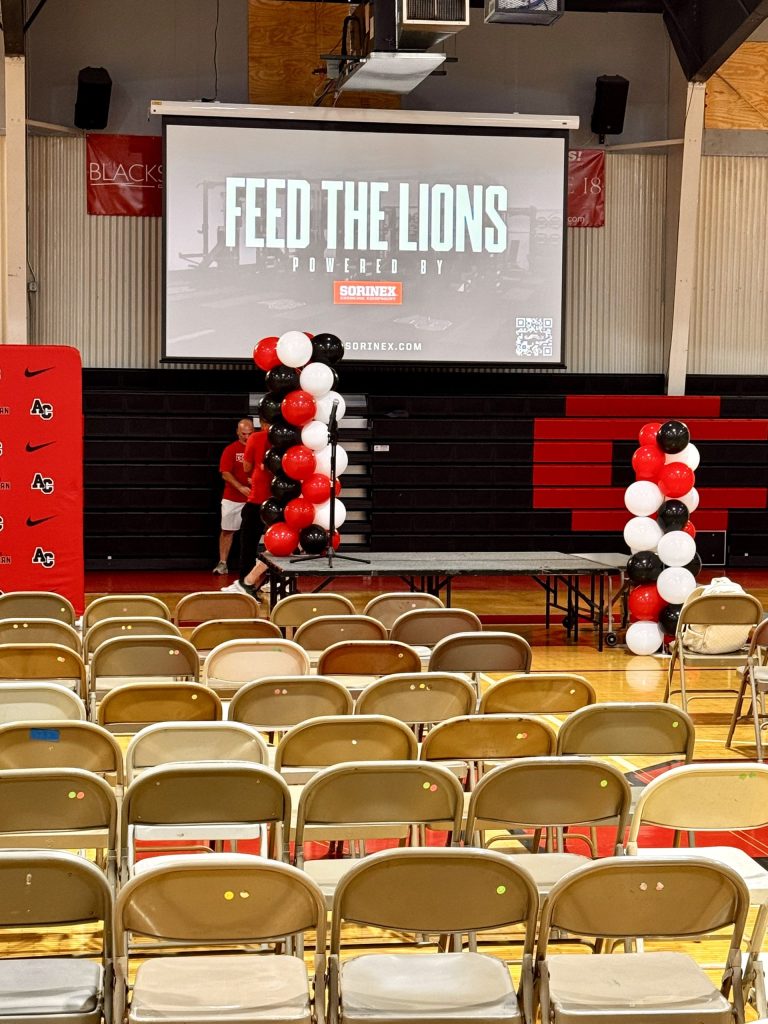
I keynoted at 7:40.
When I was finished, Brent Strickland spoke about the cognitive benefits of the FTC approach and his scientific findings. Brent had three test groups. Speed was tested on all three. One group did no “Atomic Speed Workouts,” another did one per week, and a third did two per week. When retested, the improvements in max velocity were 3%, 5%, and 8%, respectively. This result is no surprise to Feed the Cats coaches.
Tyler Thielges, the final speaker, tied everything together, and the kids returned to the five test sites, while the parents returned to the food and the music continued to play. To say there was a “joyful vibe” would be selling the night short.
I was impressed that kids of all ages and sizes, both boys and girls, seemed to find athletic testing fun… not silly fun, but competitive fun. I even witnessed parents eager to test their athletic abilities. It was close to 10 pm before the evening wound down. I’m sure the kids slept well.
MY PRESENTATION
I led off with videos of my grandchildren (Kendrick, Axel, McKenna, and Marlowe) sprinting in slow motion. Their joy was impossible to miss.
I followed up with what I called “I have a dream.” I envision a future where my grandchildren attend schools that don’t steal their joy. I showed a slide of Mind-Body-Spirit.
I presented clips of excellent coaches effectively teaching, coaching, and encouraging athletes with respect, not the “hard coaching” that so many embrace. (I showed clips of “hard coaching” as well.)
What is the PE problem?
- Kids don’t like PE (too basic for good athletes, too demanding for non-athletes)
- Kids don’t want to work (lazy, entitled, insubordinate; you’ve heard it all before)
- PE teachers reflect their students (if students are miserable, teachers are miserable)
- PE programs typically don’t improve physical fitness (never mistake activity for achievement!)
- There are life-long ramifications for unfit kids (unfit kids grow into unfit, unhealthy adults)
I spoke of the work of Brad Fortney (Enterprise, AL), Alan May (Stewartville, MN), and Alec Holler (Edwardsville, IL).
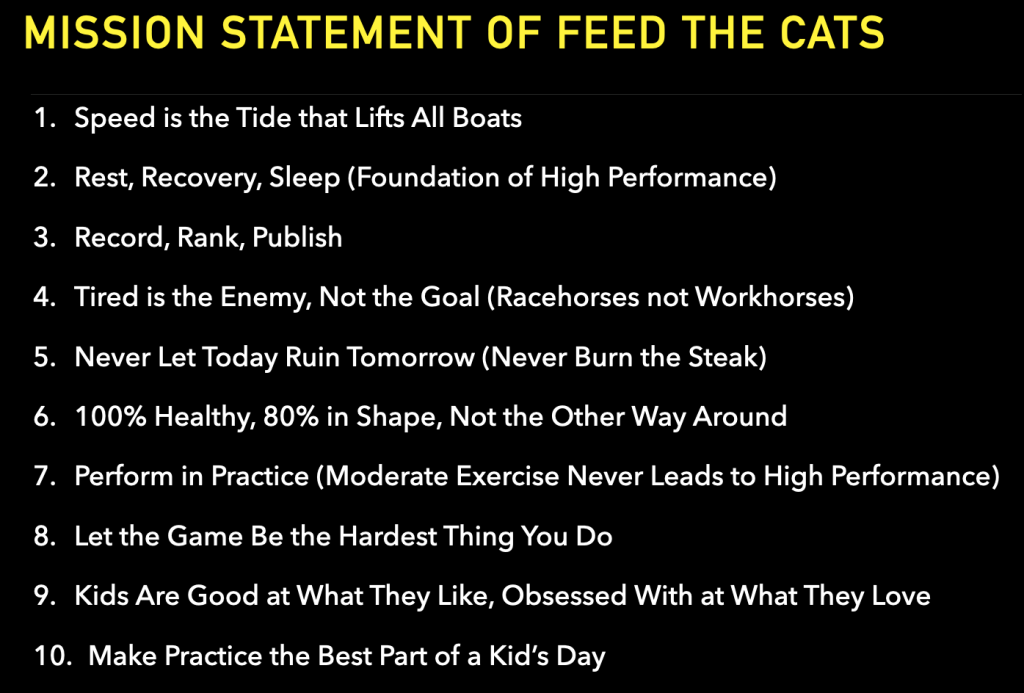
Brad, Alan, and Alec have been creative in developing a Feed the Cats athletic training program for PE. The mission of FTC is to get kids better at athletic KPIs (key performance indicators). To become an apex predator athletically, kids need to sprint fast (the priority), lift heavy, jump high/far, bounce, and throw. All of this work is done on a foundation of rest, recovery, sleep, and nutrition.
The idea is simple. Let’s compete and measure performance. Timed sprints, timed shuttles, timed efforts on a SHREDmill, measured vertical jumps, measured standing broad jumps, and anything else that’s important and can be accurately measured.
If you don’t time sprints and then record, rank, and publish them, you are probably “just running.” Kids respond to a gamified approach, even if it’s hard work.
Some may think this is an attempt for coaches to hijack PE to turn their school into a sports juggernaut… an athletic factory. Guilty as charged! Heck yes, we want kids to be outstanding athletes! But I can argue that the greatest impact will occur with non-athletes.
I told the crowd of around 600 that athletes in our country have never been better. Look at high school track & field performances now compared to 50 years ago. It’s like comparing varsity performances to JV performances. Check this out: At the IHSA (Illinois) State Track Meet in 2005, only 21 athletes ran sub-11:00 in the 100 meters; twenty years later, that number was 55. That’s a 262% increase. Despite a chilly start to the track season in Illinois, 89 sprinters have already recorded a sub-11. There are five weeks of excellent weather coming up! Athletes have never been better!
I can also say the athleticism (fitness) of non-athletes has never been worse. It’s so bad that it should be considered a public health emergency. Without a healthy, fit childhood, one could argue that the long-term health ramifications should scare us all. (And mental health is directly proportional to physical health.)
The answer is gamification. Stop playing poker with meaningless chips; play for real money. Create a carnival-like atmosphere for testing. Testing is training; training is testing. Keep score. Record, Rank, and Publish.
Stop teaching sports skills to kids that don’t want to learn them. Every successful athlete watched sports, then played them. Instruction is overrated. Provide kids with the fitness required to play a sport effectively. Stop holding back outstanding athletes in PE; let them perform and improve. Most importantly, take the overweight non-athletes and give them physical literacy. Give them the gift of athletic fitness and watch their confidence grow. Change lives.
Have you ever asked a young kid to clean his room? It never goes so well. Change the whole scene by turning it into a game. “Clean your room, and I’m going to time you!” Then watch and be amazed.
Alec Holler and his wife, Tanya, teach middle school PE together. I’m sure their marriage is tested on a daily basis!
Alec tells me the “Pacer Test” (sometimes called the “Beep Test,” measuring endurance) is the worst day of the year for PE students and PE teachers (funny how those things go together). This year at Lincoln Middle School was no different. The Pacer Test was a miserable day. But then, leaderboards were posted. When a make-up test was scheduled for those absent for the original test, dozens of kids chose to redo their test to improve in the standings. What? You mean that “kids these days” aren’t always lazy?
Kids will choose to do hard things if you gamify the work! Of course they will.
This is not new to outstanding coaches. It might be new to others.
Brad Fortney, Alan May, and Alec Holler are always actively promoting. You can use stickers, wristbands, speeding tickets, bulletin boards, rankings, and social media recognition to enhance the significance of fitness. Don’t forget to celebrate that kid who improves from 7.50 to 6.14 in the 40-yard dash (18% improvement), which recently happened in Alec’s class! Those are things that make a PE teacher’s day (and the kid’s day!).
After speaking about FTC-PE, I pivoted to sports.
It’s strange, but I don’t talk about Feed the Cats track & field much anymore. Most open-minded sprint coaches are doing it already. FTC has produced sprint times that rewrite record books. The data is so compelling that I feel like I’m preaching to the choir. It’s football and other sports that need to hear the FTC message.
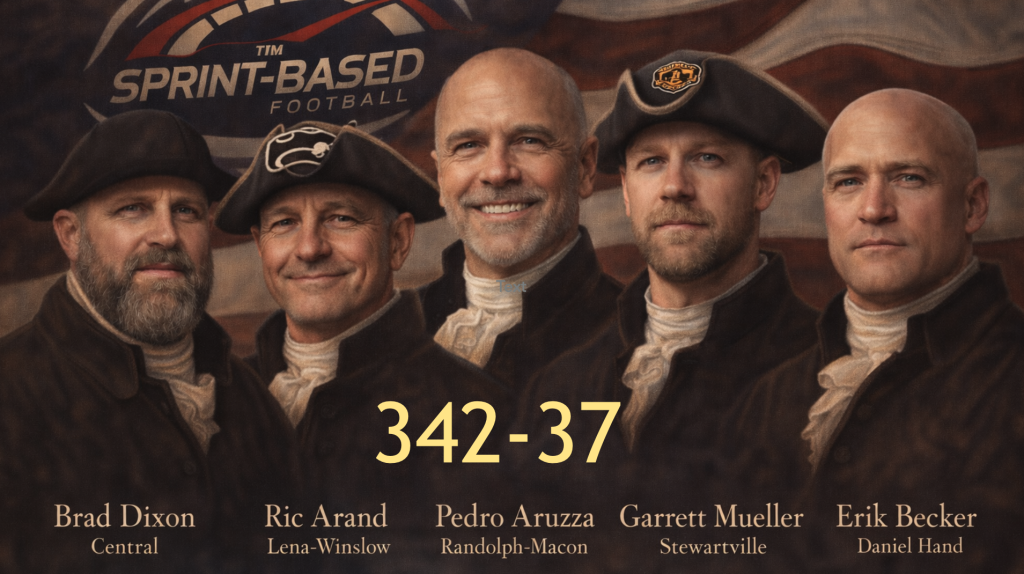
The early adopters of FTC football (aka Sprint Based Football) have gone 342-37 (.902). Brad Dixon, Ric Arand, Pedro Arruza, Garrett Mueller, and Erik Becker are considered the “Founding Fathers” of SBF.
I just spent a weekend in Homer, Alaska, where football coach (and AD) Justin Zank has won back-to-back state championships with shorter practices, consistently timing sprints, and doing no conditioning. He also makes football practice the best part of a kid’s day.
When Ravenwood’s (TN) Dan Quesenberry started feeding the cats in 2023, their football team had 8 guys running 20 mph. Two years later, that number grew to 54! What is their football record over the past two seasons? 27 wins, 2 losses.
The NCAA championships by Indiana and Wisconsin River Falls (D3) have given further credibility to the sprint-based approach. Indiana started 21 of their game-one starters against Miami in game #16. Wisconsin River Falls started all 22 of their game-one starters in their championship against North Central College. It’s a mind-blowing fact that sprint-based football teams seem to develop bulletproof players.
I told the audience how Saquon Barkley changed his off-season approach after talking to me (February 28, 2024) two weeks before signing with the Eagles. A sprint-based approach made him leaner, younger, and faster (I sent him those three words in a text after he gained 255 yards against the Rams in 2024).
These principles can work for all sports.
Trying to make a connection with sports that do not seem to require basic athleticism, I told the story of Brian Kula, renowned for training Christian McCaffrey, who trained the two female golfers. They were trained to sprint, lift, jump, bounce, and throw, even though golf requires none of those things. They got two mph faster (significant, game-changing improvement). Incredibly, their club speed improved by over 15 mph!!! Better athletes make better golfers.
I ended the night talking about my favorite word, encouragement. Coaches and teachers can change lives, and their work can echo through future generations. It’s like the people who plant trees so that their grandchildren can benefit from the shade.
Augusta Christian might be a catalyst for schools everywhere to move to a gamified fitness-based approach to PE. Kids are good at what they like, obsessed with what they love.
#FeedTheLions
#MindBodySpirit
Tony Holler
(630) 849-8294
Want to learn more? Check out the podcast here:
“The Augusta Project” featuring Tony Holler, Bill Brindley, Tyler Thielges, and Brent Strickland:
Link: FTC PE PODCAST
(Feed the Cats Podcast also available on Spotify and Apple Podcasts.)
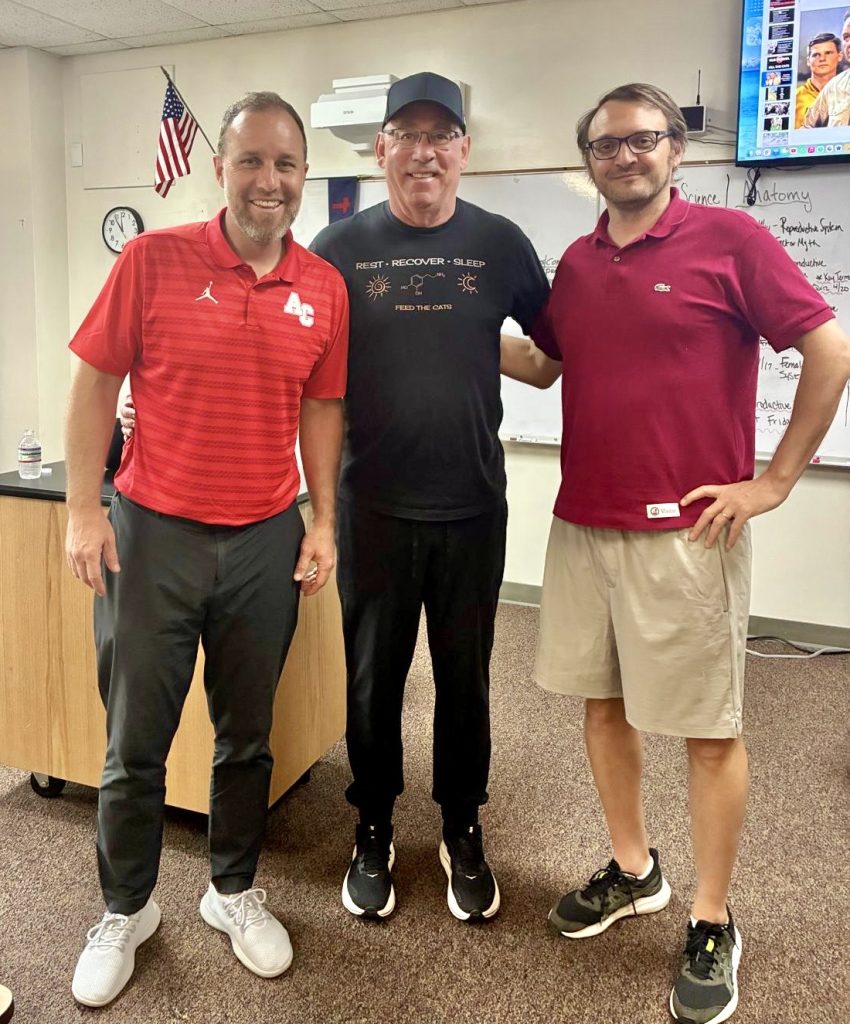
Bill Brindley (AD at Augusta Christian), Tony Holler, Brent Strickland (France)
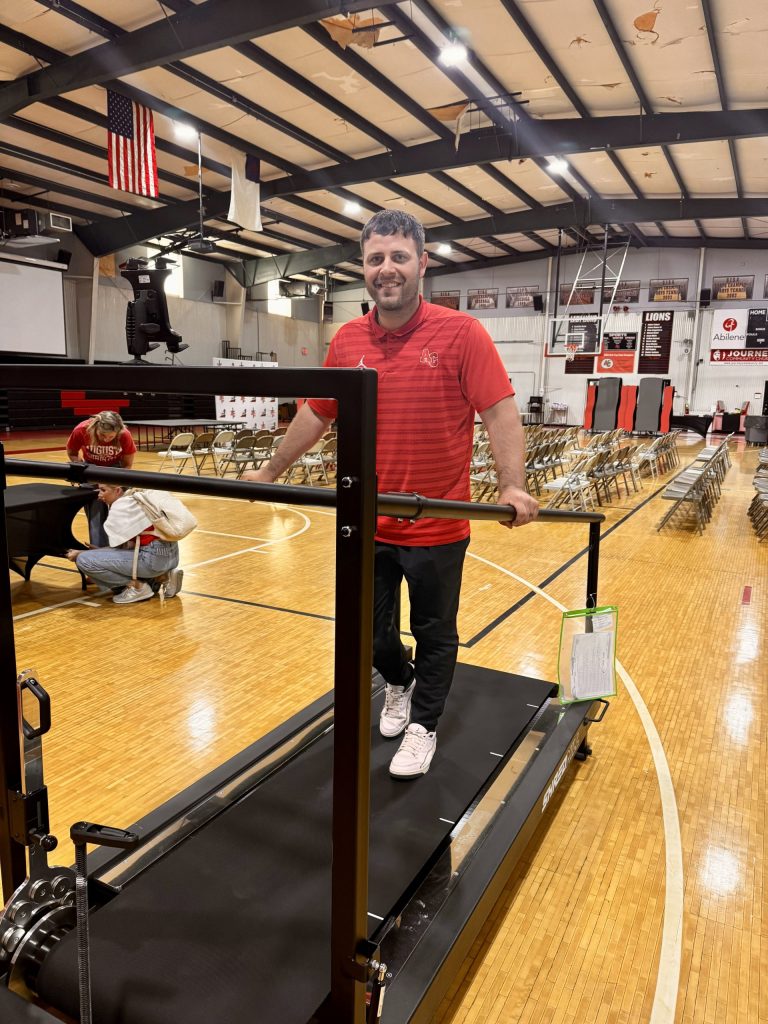
Tyler Thielges getting the SHREDmill ready.
Looking for technology for training athleticism?
 SimpliFaster