
 10 QUESTIONS ABOUT SBF
(1) What the hell is Sprint-Based Football?
Sprint-Based Football is a low-dosage approach to coaching football that prioritizes speed over endurance, prioritizes winning over outworking your opponents, and prioritizes performing instead of grinding in practice. Players love practice. Coaches are reborn. Teams win.
Sprint-Based football applies Feed the Cats principles specifically to the sport of football.
The two coaches who adopted the Feed the Cats approach first were Ric Arand of Lena-Winslow and Brad Dixon of Camp Point Central. Since adopting Sprint-Based Football, they have a combined record of 167-18. They have won 90% of their games.
(2) But what about the aerobic base?
Traditional, standard S&C education included this paragraph: “Without a good aerobic base, an athlete will struggle to recover during high-intensity exercise. Our body’s “low-intensity” aerobic energy systems help our “high-intensity” systems (ATP-PC and anaerobic glycolysis) recover and prepare for our next bout of activity.”
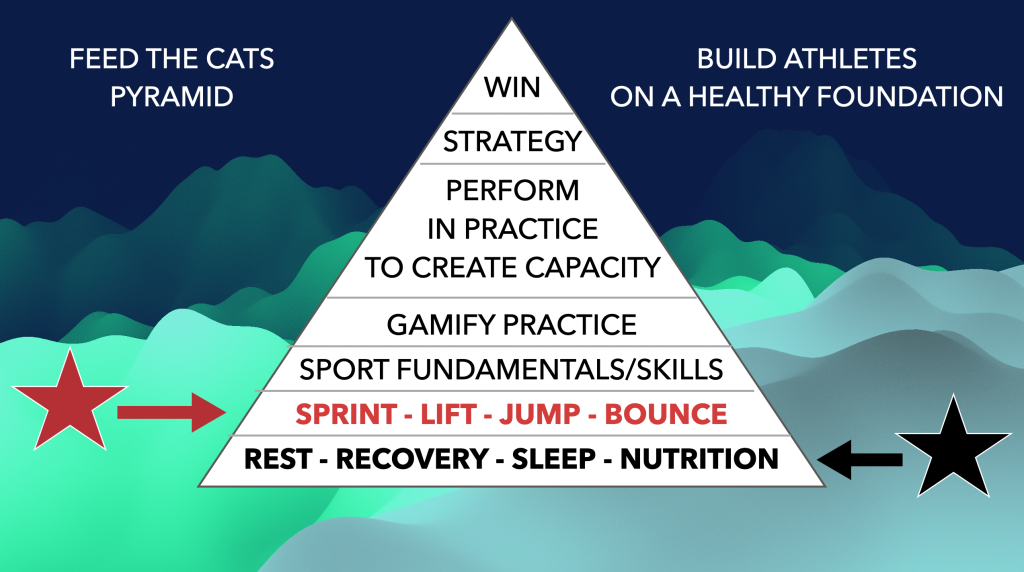 In sprint-based football, teams prioritize athleticism in the offseason and in-season.
“Speed is the priority, not the majority.” ~Tony Villani
Stacking high-quality anaerobic work will provide football teams with the aerobic CAPACITY to stack high-quality anaerobic work in games.
“We don’t stretch, we don’t run sprints, and we don’t practice on Mondays and Fridays. And when we do practice, we never go longer than an hour and forty-five minutes. We don’t waste the player’s time.” ~Hal Mumme (Air Raid)
There are those who will VIOLENTLY oppose this idea, but none of them have actually experienced a sprint-based approach. You only know what you know. Sprint-based football teams win the fourth quarter.
Fast players don’t fatigue like slow players. (Game speed is easier for fast players.)
There’s a reason why the NFL Combine has no test for endurance.
(3) But what about the weight room?
Be general in the weight room, extreme in speed training, and specific in practice.
Never let lifting interfere with speed or the sport in season. (Never sprint after lifting; always sprint fresh.)
I apologize for the brevity of my answer. In my opinion, the weight room is something football programs get right.
(4) Shouldn’t we strive to outwork our opponents?
Sprint-based football teams practice “the disciplined pursuit of less.” Practices are short, and enthusiasm is high. Never let today ruin tomorrow.
Pedro Arruza at Randolph-Macon (Virginia, D-3) is 57-7 using Feed the Cats principles (aka Sprint-Based Football). His first four practices: 60 minutes, 60 minutes, 60 minutes, off.
Garrett Mueller (28-game winning streak, 2 state titles, MN), using Titan Sensors, found his Monday through Thursday practice volume to equal his game volume.
(5) Why prioritize max velocity?
Speed is the tide that lifts all boats. Speed is neurological. It’s more electrical than muscular. (The strongest are seldom the fastest.)
Improvements in the CNS have a global effect. As golfers grow faster, they develop faster club speeds. As volleyball players grow faster, they jump higher and move quicker. Slow 325-pound offensive tackles don’t get drafted. Fast offensive tackles don’t fatigue quickly, they have long careers, and they get rich.
Fast athletes are excellent accelerators. Get faster and acceleration improves.
When I asked Kyle Bolton (now at Oregon) why TCU conducted max velocity training during the season in which they played for the NCAA National Championship, he gave me a one-word answer: “HEALTH.”
We don’t know why, but exposure to max velocity contributes to the durability of athletes. When an athlete is fast compared to his former self, he’s healthier. Healthy is fast and fast is healthy.
Every sprint-based football coach can show you data proving their team was faster at the end of the season than they were at the beginning. The opposite was true in old-school football.
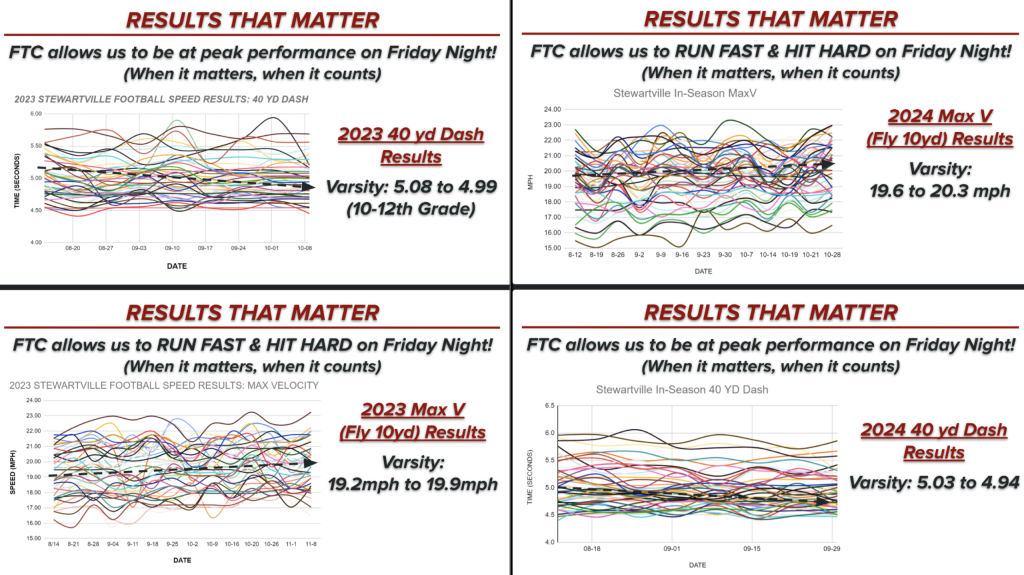
Instead of grinding athletes (hard, dull work), Coach Garrett Mueller prioritizes speed. If a team gets FASTER in-season and their opponents get SLOWER, I’d call that a COMPETITIVE ADVANTAGE.
In Stewartville’s two state championship games, only one rostered player was unable to play, supporting the concept that being fast equals being healthy! More than 99% of Stewartville’s opening day rosters played in those two championship games!!!
(6) How and when should football teams time sprints in the season?
Expose players to max velocity twice a week. It can be as simple as doing my Atomic Speed Workout (15 minutes, only 60 seconds of work).
It can be as simple as doing high-quality feed drills and timing two 40s. If you have 80 players: 4 lines of 20, 4 coaches with a stopwatch, and 4 clipboards for recording times. The speed workout replaces your warmup. As TCU’s Zach Dechant says, “Our workout is our warmup and our warmup is our workout.” (He also says training should be FRESH, FAST, FREQUENT, & FUN.)
Many SBF teams have invested in Freelap, Dashr, or ArenaGear.
(USR is the perfect complement to Sprint-Based Football. Les Spellman’s Universal Speed Rating is a data-driven platform designed to measure, compare, and enhance athletic speed using a standardized, science-based approach.)
Monday is an ideal day for timing sprints because athletes need to be fresh.
The second day is complicated. I teach the Wave Theory. Wave theory is a variation of the high-low training method, which I refer to as Performance Days (high) and Fundamental Days (low). If your Wednesday is LOW (fundamental), then Thursday becomes your second speed day.
Another option is to do it on game day. The Atomic Speed Workout is only 60 seconds of work, and it seems to caffeinate the nervous system. It potentiates the next thing, whether it’s lifting, practice, or a game.
I recently spoke at Roxana H.S. near St. Louis. They speed train on game day! Their first year of SBF was 2023 (12-1, averaging 47.5 ppg). In the playoffs, their first game was on a Saturday. They speed trained and posted a 50-0 lead at the half against Paris H.S.
(7) Truck Stick?
It’s simply the weight of a player in kilograms multiplied by their maximum velocity in meters per second. Here’s a spreadsheet that does the calculations for you. Small and slow is not a wining formula!
(8) Isn’t practice supposed to be miserable?
Traditionally, yes. Practice was the hell you had to go through to play in the game.
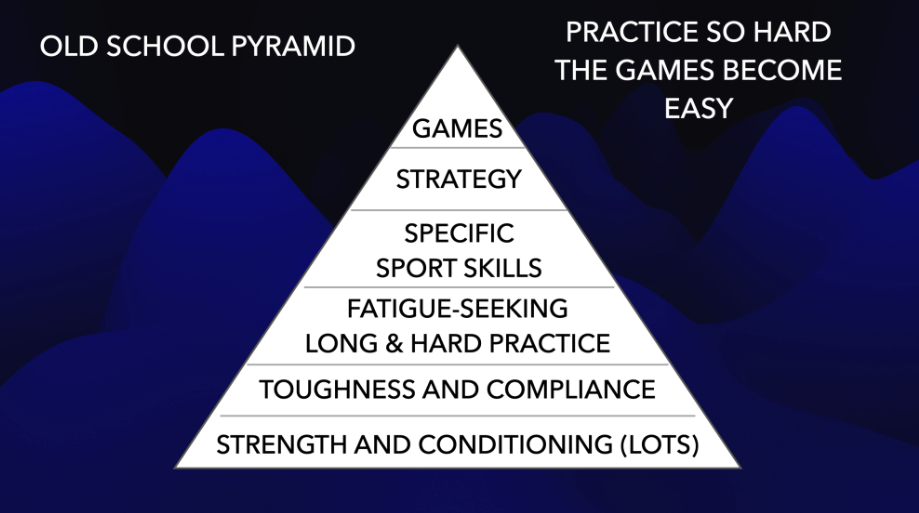 Norman Dale in Hoosiers said, “My practices aren’t designed for your enjoyment.”
When you make practice the best part of a kid’s day, their performance improves. Kids are good at what they like and obsessed with what they love.
Today’s athletes have hundreds of options. The boot camp mentality will not improve your numbers.
Speaking of numbers, over 50% of the boys attending Camp Point Central H.S. are out for football this year! What? If the #1 rated team in Texas (Duncanville H.S.) had 50% of their male population playing football, they would have over 1,100 players!
Dan Quesenberry (Strength & Speed Coach, Ravenwood H.S., TN) reports that Ravenwood has 176 boys out for football this year. Their sprint-based football team went 13-1 last season, averaging 34 ppg.
Sprint-Based Football attracts athletes.
(9) Why is tired the enemy?
GPS has taught us that practice volumes are the #1 cause of injury. A fatigued body can’t protect itself.
Skills are poorly learned when tired. Try 3-stepping the high hurdles after a 6-mile run!
Tired athletes are slow athletes. Practicing slow does not promote speed. (Don’t know why these things need to be said, but they do!)
Vince Lombardi once said, “Fatigue makes cowards of us all.” We don’t want cowards in practice (or games).
Every football coach begs for “The Three E’s”: Energy, Excitement, and Enthusiasm. When you run the cat out of your athletes, those qualities become manufactured and artificial. High-quality, low-dose training fuels “The Three E’s”.
Low doses of training stimulate, moderate doses inhibit, and large doses kill.
The 4th quarter of a game will be difficult, just as the end of a 400m race will always hurt. You can run a thousand gassers, and it will still be difficult. Let the game be hard. Make sure your players are 100% fast and explosive going into games.
The goal entering every game is to be 100% healthy (fast/explosive) and 80% in shape, not the other way around.
Game speed will wear you out if you are slow. Be fast. (Speed reserve is an alternative way to be in “in shape.”) Football players who play one way experience less than five minutes of football action.
(10) How do I learn more?
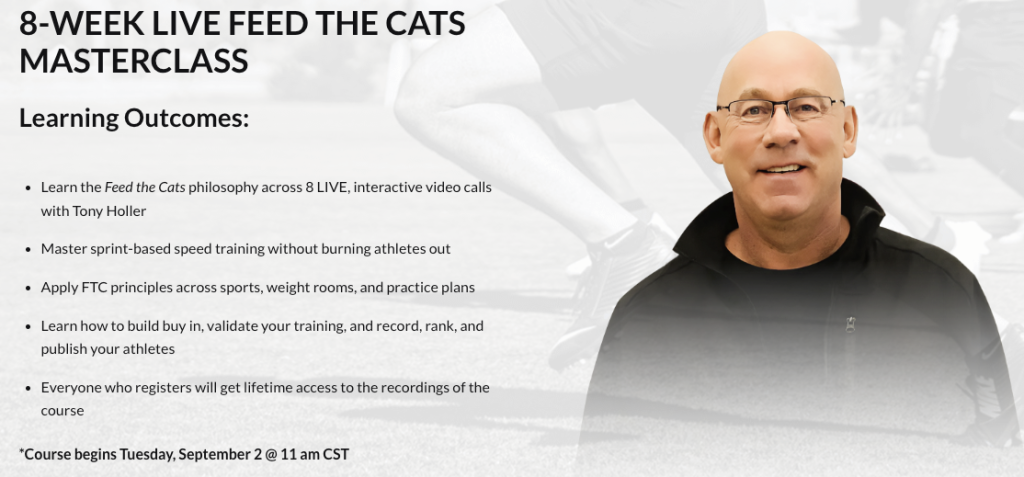
I am doing a Feed the Cats Master Class with Universal Speed Rating.
For eight consecutive weeks on Tuesdays beginning Sept 2nd, I will be delivering a presentation of 40-60 minutes followed by 30 minutes of Q&A. Those who can’t attend live will receive lifetime access to the recordings.
If you are a head football coach, consider having an assistant take the course. Over ten hours of instruction. Only $149.
Sign-up link: Feed the Cats Master Class
The deadline to register is Friday, August 29th.
BONUS: FIRST-EVER BOOK WRITTEN ABOUT SPRINT-BASED FOOTBALL: FREE!
Here is an eBook created with excerpts from my Sprint-Based Football Podcast (Spotify and Apple Podcasts).
100% Free!
